Three tests at a special price – price category 1
99,00 €
Understand your health – this is how it works
Order a test package online
Add body composition analysis and a ready-made laboratory package to your shopping cart, supplement with individual tests or create your own complete package. All tests are available without a physician's referral.
Visit a location
Specimen collection is smooth at Mehiläinen's laboratories in over 75 locations. There are 22 body measurement points in shopping centers across Finland. The visit is quick – performing the test takes only a few minutes.
View results
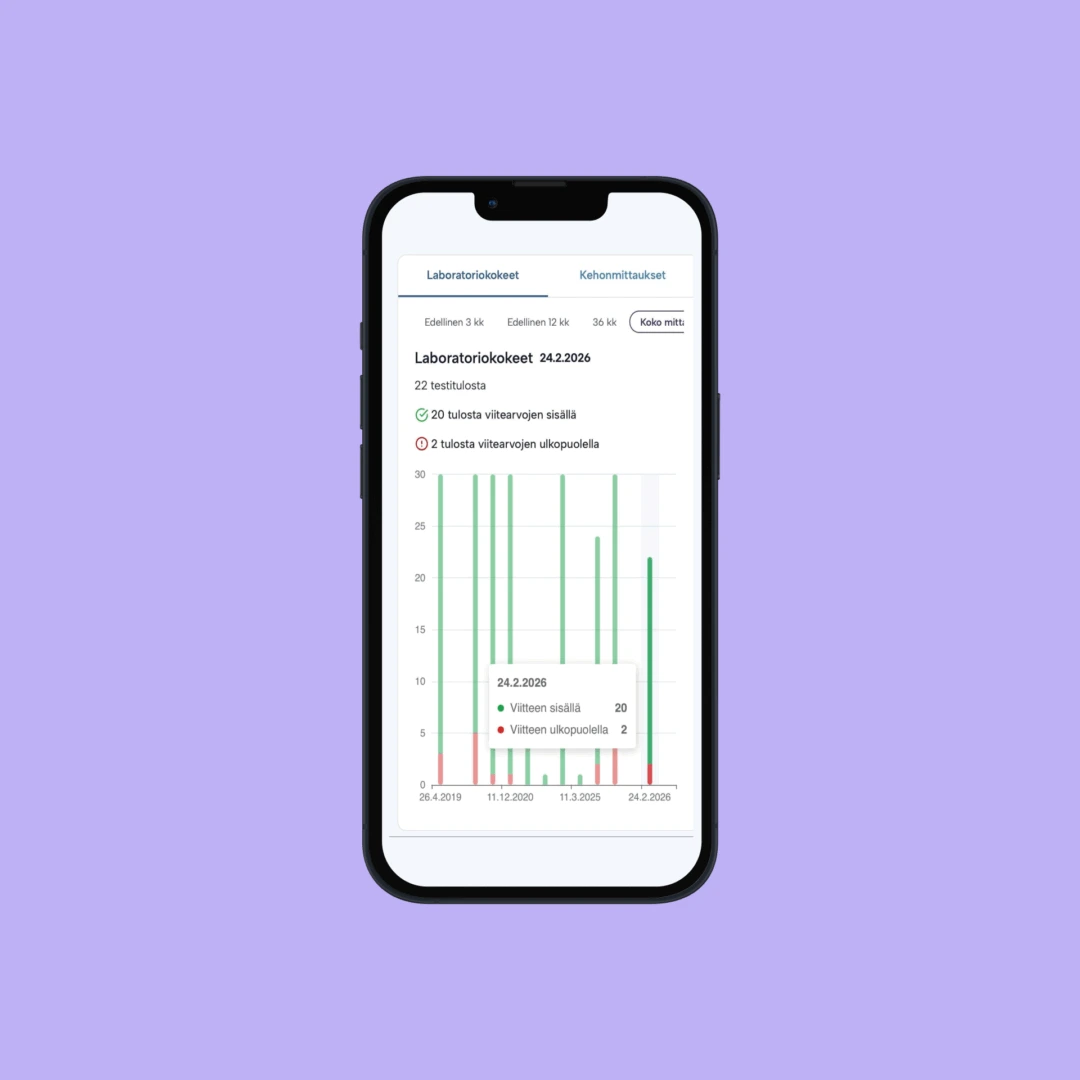
You can conveniently view the results in the OmaPuhti report. The report clearly shows your values and tracks your progress.
Frequently Asked Questions
The results are displayed as an easy-to-read report in the My journal section. We have tried to make the report as simple and clear as possible. We have received a lot of praise from our customers for the clarity of our reports!
The results can be viewed on mobile or on a computer. The results are presented graphically, and the next time you get tested, the new results are updated in the same graphs. In certain tests, the value is not accurately determined after a certain limit, because it has no diagnostic significance.
If the value is marked with red, the value falls outside the reference values. If the value is marked with green, it falls within the reference values. Some of the values also have a yellow area between them, which indicates a small deviation from the reference values.
The results can be saved as a PDF file that opens with Adobe Acrobat, for example. If you wish, you can also print the results on paper.
See an example of a Puhti report here.
You can see the results in the MyJournal service, which you log in to with your Finnish bank account credentials.
We will clearly illustrate with a report which values are within the reference range and what the results mean. When all the results are ready, you can print or download them in PDF format. The results of body composition measurements will also be visible in OmaKanta from early 2026.
If you wish, you can order a remote doctor's consultation directly from MyJournal for an additional fee. The service does not include automatic medical interpretation or diagnosis - if you suspect an illness or have symptoms, seek a doctor's opinion.
Please note that most of the test packages do not require fasting. More detailed information can be found on the page of each test panel or individual test. Individual tests that require fasting are marked with a lowercase letter f in the test code.
Try to sleep, eat, drink, exercise and work normally during the days before the test. The day before the test, try to have your meals at your usual mealtimes. Heavy stress or an intense sports performance on the previous day or the same day, for example, can also affect the values.
Sample collection for Puhti tests is possible at more than 75 locations in 50 cities. The sample collection takes place at Mehiläinen laboratories. First, order the test package of your choice on the Puhti website. The laboratories are centrally located in cities. You can check the locations of the laboratories here. You can make an appointment here.
Puhti's body composition measurements are done as a self-service in the largest shopping centers. You have access to 24 shopping centers across Finland. You can find these shopping centers on the locations page.
We recommend getting tested right away so that you can keep track of changes in your health. It is a good idea to find out the baseline before starting your exercise regimen or making other lifestyle changes so that you can see the effects of the changes in your test results. Seeing how your test results improve can motivate you to continue with your lifestyle changes. The baseline results and follow-up test results are updated on the same report in My journal, making it easy to see your progress.
You don't need a referral. You can purchase blood tests directly from Puhti's website and have the sample taken at a Mehiläinen location. If you suspect an illness or have worrying symptoms, contact your doctor. If you wish, you can order a remote doctor's consultation for an additional fee after the tests are completed in the MyJournal service.
You can add the desired individual tests to the ready-made test panels. The tests in the order are taken at the same time; tests in the same order cannot be divided into different testing days.
You can complete your order by ordering new tests from the Puhti website. In the laboratory, the sampler will see all your open orders. Tell the sampler that you want to combine the sample collection. This way, all samples will be taken at one time.
All tests from the same order will be taken at one sampling time. You cannot divide the tests from the same order into different sampling days.
Note! Puhti tests cannot be purchased directly from the laboratory cashier. The order is always made online.
This instruction does not apply to body measurements at self-service points, which are taken separately.
The order must always be filled in with the details of the person to be tested. If you want to order tests as a gift for someone else, gift cards are available. The gift card is used in Puhti’s online store, and the recipient of the gift can decide which test package they want to order.
If you want make changes to the tests you have ordered, you can request a change to your order from our customer service before visiting the laboratory. You can contact us via the chat on our website or by phone (+358 (0)10 338 7049).
If the order includes promotional or special offer products or test panels with a lower than normal price, we will not be able to refund the amount in full; in this case, we will refund the price paid for the product. If a product is exchanged for another, we will take into account the difference between the products and the lower price in the amount of refund.
Please note that we do not make changes to an order that has already been used. In other words, any changes to the order must be made before visiting the laboratory. After visiting the laboratory, we will not refund used orders or parts thereof.